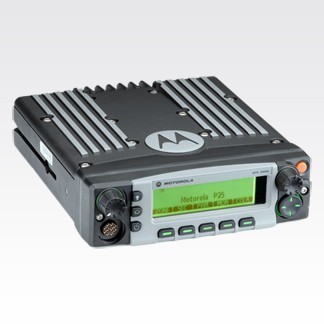
APCO P25 Mobile Radios, ICOM, VERTEX, MOTOROLA, MIDLAND
P25 was established to address the
need for common digital public safety radio communications standards
for First Responders and Homeland Security/Emergency Response professionals.
TIA TR-8 facilitates such work through its role as an ANSI-accredited
Standards Development Organization (SDO).
Project 25 (P25) is a set
of standards produced through the joint efforts of the Association
of Public Safety Communications Officials International (APCO),
the National Association of State Telecommunications Directors
(NASTD), selected Federal Agencies and the National Communications
System (NCS),
and standardized under the Telecommunications Industry Association
(TIA)...
The P25 suite of standards involves digital Land Mobile Radio
(LMR)
services for local, state/provincial and national (federal)
public safety organizations and agencies...
P25 is applicable to LMR equipment
authorized or licensed, in the U.S., under the National Telecommunications
and Information Administration (NTIA)
or Federal Communications Commission (FCC)
rules and regulations.
Although developed primarily
for North American public safety services, P25 technology and
products are not limited to public safety alone and have also
been selected and deployed in other private system application,
worldwide.
P25 equipment has also been selected for a railroad system, including rolling
stock, personnel, and transportation vehicles.
P25-compliant systems are being increasingly adopted and deployed. Radios can
communicate in
analog mode with legacy radios, and in either
digital or
analog mode with other P25 radios. Additionally, the deployment of
P25-compliant systems will allow for a high degree of equipment interoperability
and compatibility.P25 standards use the Improved Multiband Excitation (IMBE)
vocoders which were designed by DVSI to encode/decode the analog audio signals.
P25 may be used in "talk around" mode without any intervening equipment between
two radios, in conventional mode where two radios communicate through a repeater
or base station without trunking or in a trunked mode where traffic is
automatically assigned to one or more voice channels by a
Repeater
or Base Station.
The protocol supports the use of DES encryption (56 bit), 2-key Triple-DES
encryption (112 bits), 3-key Triple-DES encryption (168-bits), AES encryption at
up to 256 bits keylength, RC4 (40 bits, sold by Motorola as Advanced Digital
Privacy), or no encryption.
The protocol also supports the ACCORDION 1.3, BATON, FIREFLY, MAYFLY and SAVILLE
Type 1 ciphers.
P25 Open Interfaces: P25's Suite of Standards specify eight open interfaces between the
various components of a land mobile radio system. These interfaces are:
Common Air Interface (CAI) standard
specifies the type and content of signals transmitted by compliant radios. One
radio using CAI should be able to communicate with any other CAI radio,
regardless of manufacturer
Subscriber Data Peripheral Interface
standard specifies the port through which mobiles and portables can connect to
laptops or data networks
Fixed Station Interface
standard specifies a set of mandatory messages supporting digital voice, data,
encryption and telephone interconnect necessary for communication between a
Fixed Station and P25 RF Subsystem
Console Subsystem Interface
standard specifies the basic messaging to interface a console subsystem to a P25
RF Subsystem
Network Management Interface standard
specifies a single network management scheme which will allow all network
elements of the RF subsystem to be managed
Data Network Interface
standard specifies the RF Subsystem's connections to computers, data networks,
or external data sources
Telephone Interconnect Interface
standard specifies the interface to Public Switched Telephone Network (PSTN)
supporting both analog and ISDN telephone interfaces.
Inter RF Subsystem Interface
(ISSI) standard specifies the interface between RF subsystems which will allow
them to be connected into wide area networks
P25-compliant technology is being deployed in several phases:
Phase 1
Phase 1 radio systems operate in 12.5 kHz
analog, digital or mixed mode. Phase 1 radios use Continuous 4 level FM (C4FM)
modulation for digital transmissions at 4800 baud and 2 bits per symbol,
yielding 9600 bits per second total channel throughput. Receivers designed for
the C4FM standard can also demodulate the "Compatible quadrature phase shift
keying" (CQPSK) standard, as the parameters of the CQPSK signal were chosen to
yield the same signal deviation at symbol time as C4FM while using only 6.25 kHz
of bandwidth.
Vendors are currently shipping
Phase 1 P25-compliant systems. These systems involve standardized service and
facility specifications, ensuring that any manufacturers' compliant subscriber
radio has access to the services described in such specifications. Abilities
include backward compatibility and interoperability with other systems, across
system boundaries, and regardless of system infrastructure. In addition, the P25
suite of standards provides an open interface to the radio frequency (RF)
subsystem to facilitate interlinking of different vendors' systems.
Phase 2
To improve spectrum utilization, Phase 2 is
currently under development with concurrent work being done on 2-slot TDMA and
FDMA (CQPSK) modulation schemes. Phase II will use the
AMBE vocoder to reduce the needed bitrate so that one channel will only
require 4800 bits per second.
A hand-held Project 25 radio
used in US systems.
Significant attention is also paid to interoperability with legacy equipment,
interfacing between repeaters and other subsystems, roaming capacity and
spectral efficiency/channel reuse. In addition, Phase 2 work involves console
interfacing between repeaters and other subsystems, and man-machine interfaces
for console operators that would facilitate centralized training, equipment
transitions and personnel movement.
Adoption: Adoption of these standards has been slowed by
budget problems in the US; however, funding for communications upgrades from the
Department of Homeland Security usually requires migrating to APCO-25. It is
also being used in other countries world wide including Australia, Singapore and
Russia, although the Terrestrial Trunked Radio (TETRA) systems are more popular
in Europe. And while Terrestrial Trunked Radio systems are sometimes cheaper -
handsets are often not suited to more rugged environments. Both P25 and TETRA
can offer varying degrees of functionality, depending on available radio
spectrum, terrain and project budget.
While interoperability is a major goal of P25, many P25 features present
interoperability challenges. In theory, all P25 compliant equipment is
interoperable. In practice, interoperable communications isn't achievable
without effective governance, standardized operating procedures, effective
training and exercises, and inter-jurisdictional coordination. The difficulties
inherent in developing P25 networks using features such as digital voice,
encryption, or trunking sometimes result in feature-backlash and organizational
retreat to minimal "feature-free" P25 implementations which fulfill the letter
of any APCO-25 migration requirement without realizing the benefits thereof.
Additionally, while not a technical issue per se, frictions often result from
the unwieldy bureaucratic inter-agency processes that tend to develop to
coordinate interoperability decisions.